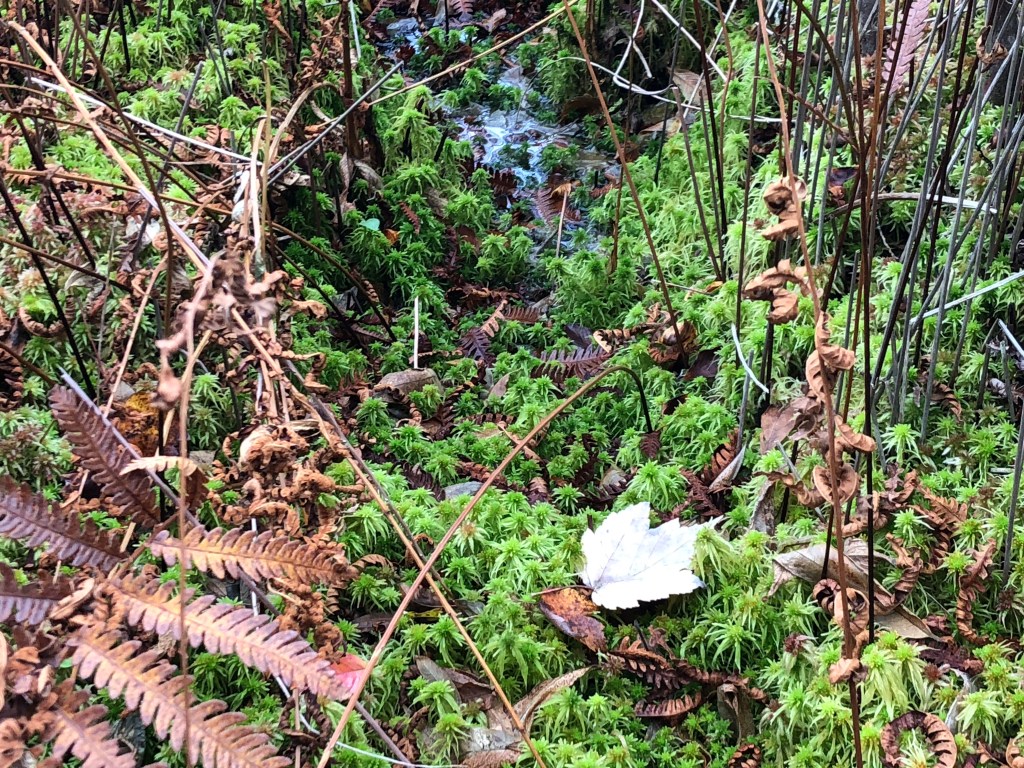
Carved out of the ground by the receding glaciers thousands of years ago, Black Pond is known as a kettle hole. It’s a small body of water and slowly shrinking due to the conquest of the bog. Stepping onto the boardwalk, the forest floor abruptly ends and a muddy, watery world beckons you to its depths. Robust bright green Sphagnum densely line the muddy banks and the bravest pioneering plants emerge from the deeper water like eyes on stalks, watching you pass. Pitcher plants nest among the moss patiently awaiting their next meal with their variegated regalia of colors and specially folded leaves that hold their corrosive digestive juice.

At the end of the boardwalk, the trees give way to tall aquatic grass, and the squelching peat allows those brave enough to continue a little further toward the pond proper. More green Sphagnum sits in the shade of the tall grass, submerged or stretching their capitula just above the water’s surface. In full view of the sun, however, a dense and extensive carpet of deep wine red Sphagnum grows with large star-like capitula that seem to mirror the sun they fearlessly worship despite the powerful UV rays. Tiny sundews emerge from this sun-drenched carpet, glistening with sticky droplets for snaring insects. Carnivorous pitcher plants, sundews and the infamous Venus fly trap are all bog specialists, requiring the high humidity and acidity of Sphagnum mats to grow. They have evolved their carnivorous lifestyles because the bog is low in nutrients like nitrogen which Sphagnum purposefully keeps in low supply to prevent other plants from colonizing the area.
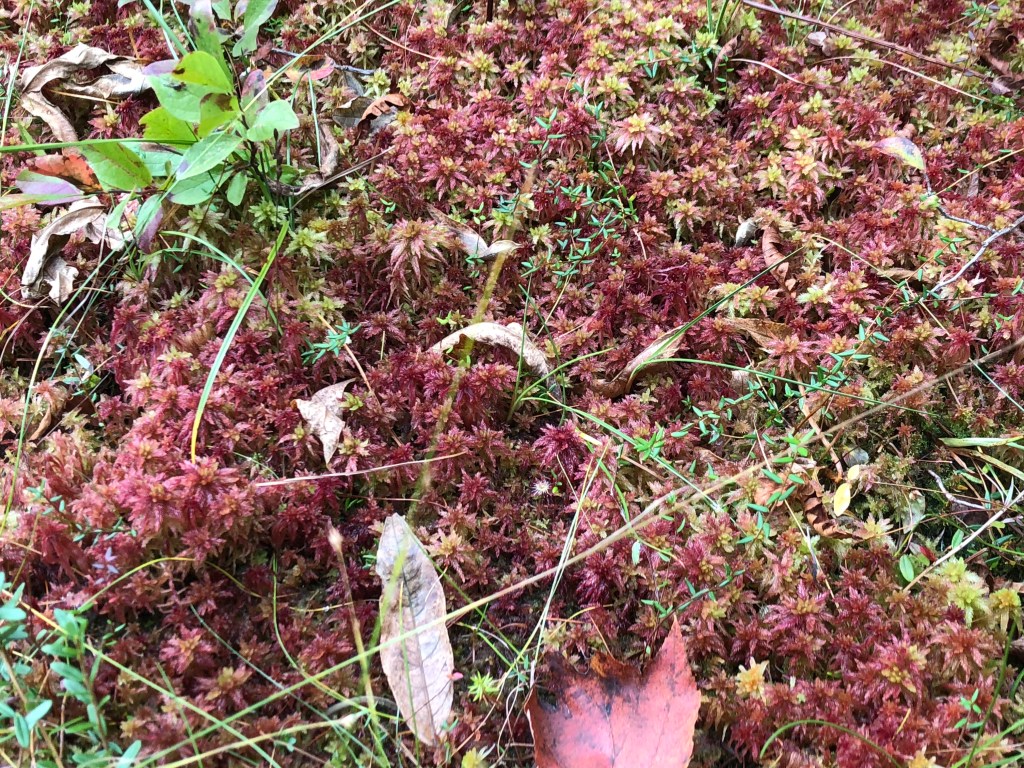
While carnivorous plants have evolved to obtain nitrogen from their prey, Sphagnum plants have a symbiosis with nitrogen-fixing bacteria that they farm within their cells[3]. The dark colors expressed by some species may provide the plants with protection from the most energetic of the sun’s light, allowing them to live where other shade-dwelling Sphagnum would not dare. Sphagnum leaves are only one cell thick, which means they have to find more creative ways to avoid sunburn than the thick waxy cuticle of other plants. Sphagnum mosses are notorious for their phenotypic plasticity, that is their ability to grow differently in response to different environmental conditions, and the same species may change color depending on the intensity of light it is exposed to[2].
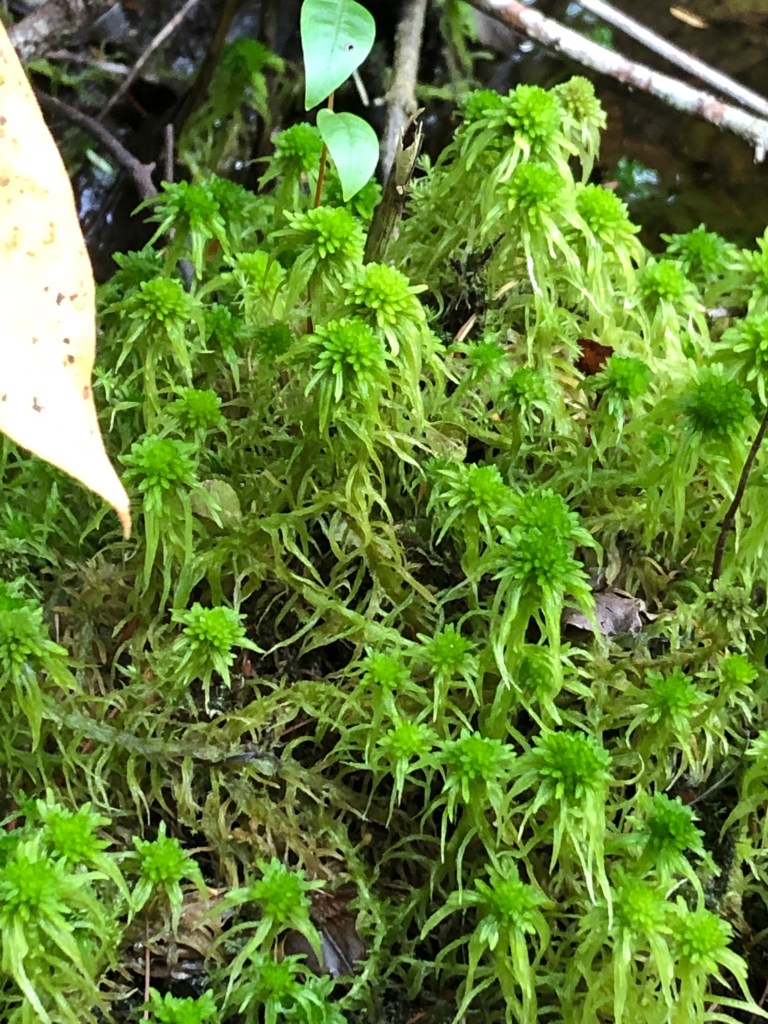
The abundance of Sphagnum at Black Pond, both in biomass and species diversity, has taken many years for the population to achieve. As more Sphagnum grows, more peat accumulates which absorbs water and provides more surface area for moss to grow on. The Sphagnum forages cations necessary for its growth in its surroundings, exchanging them for hydrogen ions chemically split from water molecules which acidifies the water and soil[1], making the environment hostile to other types of plants. As the peat accumulates and the environment is chemically engineered for its own optimum growth, Sphagnum grows in a positive feedback loop and can eventually change a pond into a bog completely filled with peat and blanketed with moss.
Find more photos of Black Pond at the links below:
References
[1]Berg, A., Danielsson, Å., & Svensson, B. H. (2013). Transfer of fixed-N from N2-fixing cyanobacteria associated with the moss Sphagnum riparium results in enhanced growth of the moss. Plant and Soil, 362(1–2), 271–278. https://doi.org/10.1007/s11104-012-1278-4
[2]Karlin, E. F., Hotchkiss, S. C., Boles, S. B., Stenøien, H. K., Hassel, K., Flatberg, K. I., & Shaw, A. J. (2012). High genetic diversity in a remote island population system: Sans sex. New Phytologist, 193(4), 1088–1097. https://doi.org/10.1111/j.1469-8137.2011.03999.x
[3]Kolton, M., Weston, D. J., Mayali, X., Weber, P. K., McFarlane, K. J., Pett-Ridge, J., Somoza, M. M., Lietard, J., Glass, J. B., Lilleskov, E. A., Shaw, A. J., Tringe, S., Hanson, P. J., & Kostka, J. E. (2022). Defining the Sphagnum Core Microbiome across the North American Continent Reveals a Central Role for Diazotrophic Methanotrophs in the Nitrogen and Carbon Cycles of Boreal Peatland Ecosystems. MBio, 13(1), e03714-21. https://doi.org/10.1128/mbio.03714-21
 The Mossy Log
Leave a comment