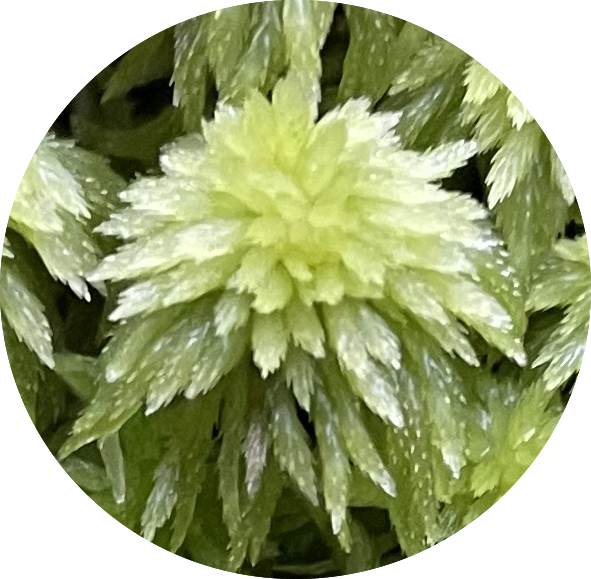
Peatlands are characterized as “nutrient poor” ecosystems[6]. This is because the acidic soils tend to be hostile to microbial life that would otherwise break down organic matter, making essential nutrients such as nitrogen available for plants to take up through their roots[7]. Peatlands produce and store huge amounts of biomass though, so the plants in these ecosystems must be getting their share of nitrogen somehow. It turns out the ecosystem engineers of peatlands, Sphagnum mosses, which are responsible for many of the characteristics of peatland ecosystems from using their absorptive capabilities to keep the soils water-logged to actively acidifying the groundwater[4], are also responsible for facilitating the availability of nitrogen.
Sphagnum tissues are comprised of two different types of cells: photosynthetic cells, in which are housed the chloroplasts that convert the sun’s energy into a form the plant can use to grow, and hyaline cells, which are empty of any organelles and are the secret behind Sphagnum’s incredible water absorbing abilities[7]. The hyaline cells also have pores, holes that are too large to be for allowing for the movement of water into the cell[5]. These pores are actually like doors for microorganisms to access the hyaline cells and use them like tiny apartments that protect them from predators and the acidity of the groundwater[3].
Sphagnum is known to host a diverse microbiome just like humans, or like a tree in a forest that has myriad birds, mammals, insects, amphibians and other plants living on and in it[5]. The organisms that call Sphagnum cells home include bacteria, fungi, algae and protists[6]. Just like in a tree, there are photosynthetic organisms just looking for a habitat, grazing microbes that feed on them, and predatory microbes that feed on the grazers, a complex food web hidden within the microscopic cells of a moss[5]. And just like in humans, some of the microorganisms that inhabit Sphagnum do not benefit their host in any way, some are parasites, harming the host for their own growth and propagation, and some are mutualists that provide benefits to the plant in exchange for the protection[5].
Genomic sequencing has revealed that Sphagnum across the world consistently hosts communities of diazotrophic prokaryotes—microorganisms that can convert atmospheric nitrogen into a form that Sphagnum can use[18]. Studies have found that Sphagnum-associated cyanobacteria, for example, down-regulate photosynthesis and this reduced capacity for carbon fixation is compensated by carbohydrates supplied by the host plant[3]. Symbiotic cyanobacteria have also been observed to have higher than normal heterocyst counts, special cells for nitrogen fixation, implying a physiological specialization not unlike nitrogen-fixing rhizobia that are hosted in the roots of legume plants[1]. There is clearly an evolutionary basis for this symbiosis because Sphagnum’s immune response is down-regulated in response to contact with cyanobacteria, allowing colonization and the development of a mutually beneficial relationship[3].
Primary productivity is dependent upon the availability of nitrogen which means the symbiosis between Sphagnum and their nitrogen-fixing symbionts is vital to the stability of peatland ecosystems and their continuing role as carbon sinks, and therefore enormously impactful to the global climate[4]. Sphagnum-associated nitrogen-fixing communities have been found to decline in diversity and activity with increasing temperature, which could mean the peatland ecosystems around the world today are in great danger from global warming[2]. The decline of these ecosystems would mean not only a loss of carbon repositories, but also carbon sponges, and understanding these processes and the organisms that drive them can help us make better projections for how our world will change in the future, and how we can prepare for it. In addition to anthropocentric concerns, these ecosystems deserve attention and protection for their own sake, as well as for the sake of the many other organisms that call peatlands home.
References
[1]Basilier, K. (1980). Fixation and Uptake of Nitrogen in Sphagnum Blue-Green Algal Associations. Oikos, 34(2), 239. https://doi.org/10.2307/3544188
[2]Carrell, A. A., Kolton, M., Glass, J. B., Pelletier, D. A., Warren, M. J., Kostka, J. E., Iversen, C. M., Hanson, P. J., & Weston, D. J. (2019). Experimental warming alters the community composition, diversity, and N2 fixation activity of peat moss (Sphagnum fallax) microbiomes. Global Change Biology, 25(9), 2993–3004. https://doi.org/10.1111/gcb.14715
[3]Carrell, A. A., Veličković, D., Lawrence, T. J., Bowen, B. P., Louie, K. B., Carper, D. L., Chu, R. K., Mitchell, H. D., Orr, G., Markillie, L. M., Jawdy, S. S., Grimwood, J., Shaw, A. J., Schmutz, J., Northen, T. R., Anderton, C. R., Pelletier, D. A., & Weston, D. J. (2022). Novel metabolic interactions and environmental conditions mediate the boreal peatmoss-cyanobacteria mutualism. The ISME Journal, 16(4), 1074–1085. https://doi.org/10.1038/s41396-021-01136-0
[4]Kolton, M., Weston, D. J., Mayali, X., Weber, P. K., McFarlane, K. J., Pett-Ridge, J., Somoza, M. M., Lietard, J., Glass, J. B., Lilleskov, E. A., Shaw, A. J., Tringe, S., Hanson, P. J., & Kostka, J. E. (2022). Defining the Sphagnum Core Microbiome across the North American Continent Reveals a Central Role for Diazotrophic Methanotrophs in the Nitrogen and Carbon Cycles of Boreal Peatland Ecosystems. MBio, 13(1), e03714-21. https://doi.org/10.1128/mbio.03714-21
[5]Kostka, J. E., Weston, D. J., Glass, J. B., Lilleskov, E. A., Shaw, A. J., & Turetsky, M. R. (2016). The Sphagnum microbiome: New insights from an ancient plant lineage. New Phytologist, 211(1), 57–64. https://doi.org/10.1111/nph.13993
[6]Reczuga, M. K., Seppey, C. V. W., Mulot, M., Jassey, V. E. J., Buttler, A., Słowińska, S., Słowiński, M., Lara, E., Lamentowicz, M., & Mitchell, E. A. D. (2020). Assessing the responses of Sphagnum micro-eukaryotes to climate changes using high throughput sequencing. PeerJ, 8, e9821. https://doi.org/10.7717/peerj.9821
[7]Weston, D. J., Turetsky, M. R., Johnson, M. G., Granath, G., Lindo, Z., Belyea, L. R., Rice, S. K., Hanson, D. T., Engelhardt, K. A. M., Schmutz, J., Dorrepaal, E., Euskirchen, E. S., Stenøien, H. K., Szövényi, P., Jackson, M., Piatkowski, B. T., Muchero, W., Norby, R. J., Kostka, J. E., … Shaw, A. J. (2018). The Sphagnome Project: Enabling ecological and evolutionary insights through a genus‐level sequencing project. New Phytologist, 217(1), 16–25. https://doi.org/10.1111/nph.14860
 The Mossy Log
Leave a comment