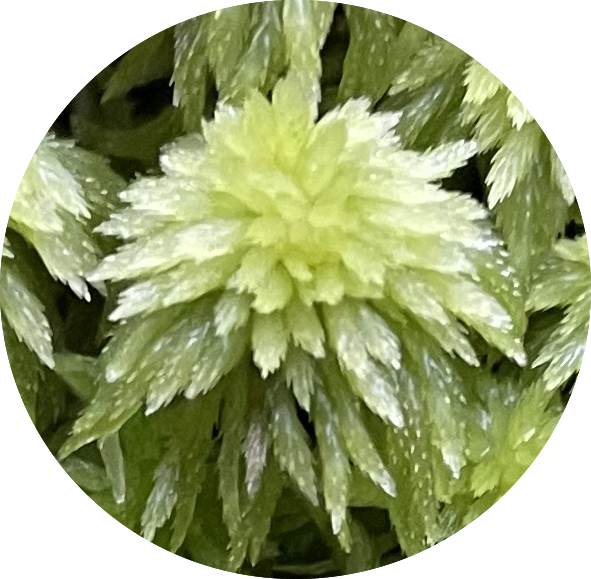
Sphagnum tissues are comprised of two types of cell: living photosynthetic cells, and dead hyaline cells[7]. As well as making Sphagnum highly efficient at absorbing and storing water, the hyaline cells also act as apartments for microorganisms to live in, sheltered from the harsh acidic conditions of the bog[2]. The Sphagnum microbiome, the community of microbes that live in and on a Sphagnum plant, is like a miniature ecosystem and includes organisms such as bacteria, archaea, viruses, algae, fungi, protists, and microscopic animals[6].
Many of the microorganisms that call Sphagnum plants home are neutral residents, neither benefiting nor harming their host. Some enjoy the buffered pH of the Sphagnum cells, some prowl the leaves of the moss, preying on their fellow microbes. There are also members of the microbiome that provide services to the plant in exchange for protection within the Sphagnum cells. This is known as a mutualism[5]. It is just like the mycorrhizal fungi that connects trees in a forest and facilitates nutrient acquisition, or the nitrogen-fixing rhizobia that live in the roots of legume plants. Or even the plethora of bacteria that live within our own gastrointestinal tract and assist with digestion. On the other hand, there are also parasites that, should conditions be favorable, will breakdown the Sphagnum tissues and proliferate as a disease[5].
Study of the Sphagnum microbiome is in its early days. Only recently have genetic sequencing methods begun to be applied to identify the microorganisms that call peat mosses home[7]. In order to understand the effect each organism has on its host, Sphagnum can be grown sterile and then inoculated with specific microbes to observe any benefit or harm[2]. Genetic sequencing can also reveal what microbes are using what genes and how that might affect the plant[4]. There is much still to learn about the many members of the microbiome and nature often resists simplicity. A microbe could have a certain effect in isolation but may behave differently in interaction with others[5]. Learning about how microorganisms affect the health of peatland ecosystems is an important field of study, though, as peatlands have an outsized influence on the climate of our planet.
Despite only occupying about 3% of the surface of the Earth today, about 1/3 of all soil organic carbon is held within the peat of these ecosystems[4]. Peatlands are critical carbon-sequestering ecosystems in this age of global warming and climate change, and their degradation could mean the release of all of that carbon into the atmosphere. The peatlands of our planet have taken thousands of years to sequester all of that carbon[3] and, like fossil fuels, they cannot be replaced once they are gone.
There are several studies currently underway that are examining how climate change may impact the microbial communities of peatlands and therefore the health of these uniquely important ecosystems. For example, the Oak Ridge National Lab is conducting the SPRUCE experiments (Spruce and Peatland Responses Under Changing Environments). These involve large chambers constructed in the boreal forest of Minnesota, in which environmental conditions can be controlled and the effects on the ecosystem observed. Experimental warming has been found to reduce the species diversity of the Sphagnum microbiome, reducing productivity and making the plants more vulnerable[5]. Increasing temperatures also cause more of the moisture in the soil to evaporate, allowing other plants to colonize, oxygen to enter the soil, and decomposers to break down the peat in a positive feedback loop, increasing the rate of release of sequestered carbon from the ecosystem[7].
Often overlooked, peatland ecosystems and their microbial communities are of critical importance to the habitability of our planet. The study of the Sphagnum microbiome is in its infancy, but that presents a huge field of inquiry that needs curious and determined minds to investigate.
References
[1]Carrell, A. A., Kolton, M., Glass, J. B., Pelletier, D. A., Warren, M. J., Kostka, J. E., Iversen, C. M., Hanson, P. J., & Weston, D. J. (2019). Experimental warming alters the community composition, diversity, and N2 fixation activity of peat moss (Sphagnum fallax) microbiomes. Global Change Biology, 25(9), 2993–3004. https://doi.org/10.1111/gcb.14715
[2]Carrell, A. A., Veličković, D., Lawrence, T. J., Bowen, B. P., Louie, K. B., Carper, D. L., Chu, R. K., Mitchell, H. D., Orr, G., Markillie, L. M., Jawdy, S. S., Grimwood, J., Shaw, A. J., Schmutz, J., Northen, T. R., Anderton, C. R., Pelletier, D. A., & Weston, D. J. (2022). Novel metabolic interactions and environmental conditions mediate the boreal peatmoss-cyanobacteria mutualism. The ISME Journal, 16(4), 1074–1085. https://doi.org/10.1038/s41396-021-01136-0
[3]Karlin, E. F., Hotchkiss, S. C., Boles, S. B., Stenøien, H. K., Hassel, K., Flatberg, K. I., & Shaw, A. J. (2012). High genetic diversity in a remote island population system: Sans sex. New Phytologist, 193(4), 1088–1097. https://doi.org/10.1111/j.1469-8137.2011.03999.x
[4]Kolton, M., Weston, D. J., Mayali, X., Weber, P. K., McFarlane, K. J., Pett-Ridge, J., Somoza, M. M., Lietard, J., Glass, J. B., Lilleskov, E. A., Shaw, A. J., Tringe, S., Hanson, P. J., & Kostka, J. E. (2022). Defining the Sphagnum Core Microbiome across the North American Continent Reveals a Central Role for Diazotrophic Methanotrophs in the Nitrogen and Carbon Cycles of Boreal Peatland Ecosystems. MBio, 13(1), e03714-21. https://doi.org/10.1128/mbio.03714-21
[5]Kostka, J. E., Weston, D. J., Glass, J. B., Lilleskov, E. A., Shaw, A. J., & Turetsky, M. R. (2016). The Sphagnum microbiome: New insights from an ancient plant lineage. New Phytologist, 211(1), 57–64. https://doi.org/10.1111/nph.13993
[6]Reczuga, M. K., Seppey, C. V. W., Mulot, M., Jassey, V. E. J., Buttler, A., Słowińska, S., Słowiński, M., Lara, E., Lamentowicz, M., & Mitchell, E. A. D. (2020). Assessing the responses of Sphagnum micro-eukaryotes to climate changes using high throughput sequencing. PeerJ, 8, e9821. https://doi.org/10.7717/peerj.9821
[7]Weston, D. J., Turetsky, M. R., Johnson, M. G., Granath, G., Lindo, Z., Belyea, L. R., Rice, S. K., Hanson, D. T., Engelhardt, K. A. M., Schmutz, J., Dorrepaal, E., Euskirchen, E. S., Stenøien, H. K., Szövényi, P., Jackson, M., Piatkowski, B. T., Muchero, W., Norby, R. J., Kostka, J. E., … Shaw, A. J. (2018). The Sphagnome Project: Enabling ecological and evolutionary insights through a genus‐level sequencing project. New Phytologist, 217(1), 16–25. https://doi.org/10.1111/nph.14860
 The Mossy Log
Leave a comment